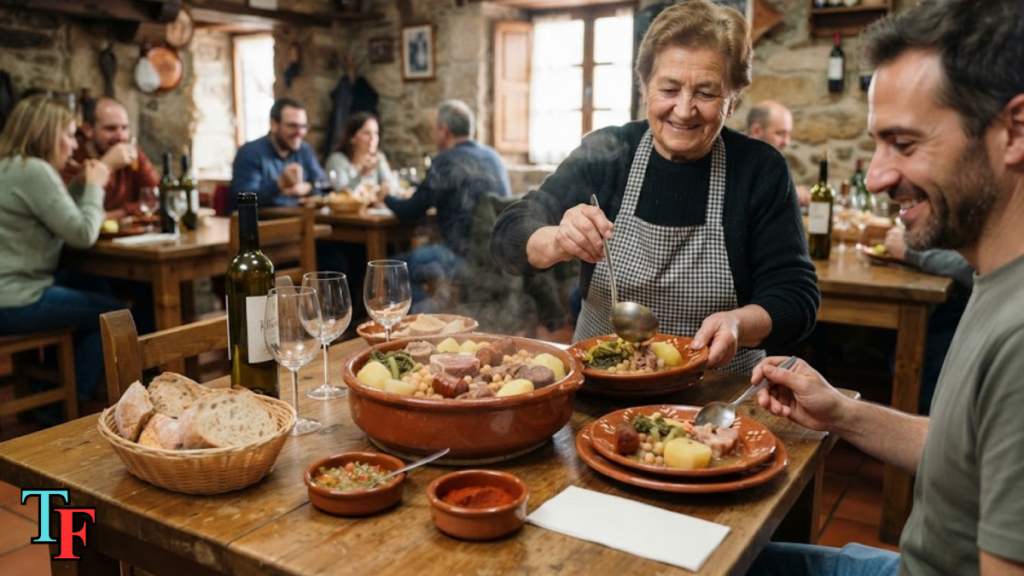

There are meals you order because you are hungry. Then there are meals that seem to take over the entire table. Cocido gallego belongs firmly in the second category.
If you are searching for the best cocido gallego near me, chances are you do not want an ordinary bowl of stew. You are looking for the real Galician experience: deeply savoury broth, salt-cured pork cooked until tender, smoky chorizo, chickpeas, potatoes and pleasantly bitter grelos, often arriving across several plates rather than squeezed into one bowl.
This is also a dish where choosing the right restaurant matters. Proper cocido requires advance preparation, especially the desalting of cured meats, and many restaurants serve it only in colder months or on particular weekends. Galicia’s tourism authority describes pork as the foundation of the dish, with grelos giving it much of its distinctive character.
Below, you’ll find genuinely researched places connected with cocido in Spain, the United States, Asia and the UK, plus the signs of a good version and a practical recipe for making it yourself. This guide will help you find, make and understand cocido gallego better than ever.
World’s Best Restaurants and Places for Cocido Gallego
There is no credible worldwide league table devoted exclusively to cocido gallego. So rather than inventing a “world’s number one”, these are standout restaurants and culinary addresses with a documented connection to the dish.
Casa Currás — Lalín, Spain
For the serious cocido traveller, Lalín is the obvious starting point, and Casa Currás is one of its most committed addresses. The family restaurant dates to 1941, and its current website says that during lunch service cocido is the only dish served. Its version combines pork, beef and chicken with nabizas or grelos and potatoes, followed in the traditional spirit by soup, bread and desserts such as filloas.
Tripadvisor currently shows a 4.3/5 rating from 146 reviews.
La Molinera — Lalín, Spain
A few doors away in Lalín, La Molinera has been serving Galician food since 1985. Its current menu lists a complete Cocido de Lalín service at €38, making this one of the easiest places to verify before travelling.
Chef Diego López Portas joined the family business in 2010, maintaining its traditional foundations while allowing a little contemporary polish into the kitchen. Tripadvisor currently lists La Molinera at 4.3/5 from 239 reviews.
Mesón de Crecente — Lugo, Spain
If glossy presentation matters less to you than old-fashioned cooking, Mesón de Crecente deserves attention. Founded in 1925 and run by Loli Lamas, this Lugo institution prepares its cocido with lacón, cacheira, chorizo, chickpeas, potatoes, grelos and cabbage; vegetables are reported to come from the family’s own garden.
That is the sort of detail I look for when assessing cocido: ingredients with a clear identity rather than an anonymous pile of boiled meat.
La Cantina by Le Tavernier — Madrid, Spain
Madrid is not Galicia, but chef Daniel Couto brought a serious Galician cocido to La Cantina by Le Tavernier in 2026. Served at the INNSiDE by Meliá Madrid Gran Vía, the weekend menu was structured in four vuelcos: noodle soup; potatoes, chickpeas and greens; chicken, chorizo, tail and trotters; then pancetta, lacón, ribs and cachucha.
It is a useful example of how ceremonial a full cocido can become.
Casa Galicia — New York City, USA
Cocido travels particularly well wherever the Galician diaspora gathers. In April 2026, Casa Galicia in New York hosted a Cocido de Lalín celebration that sold more than 400 places roughly two weeks before the event. Lalín cooks Alberto González of Casa Currás, Alejandro Iglesias and Isabel Rodríguez Louzao were involved in preparing it.
This is an event rather than a dependable daily menu, so watch the organisation’s announcements well ahead of winter and spring dates.
Hidden by DN — Taipei, Taiwan
Asia is much harder territory for finding authentic cocido. One credible lead is Hidden by DN in Taipei, associated with Galician chef Daniel Negreira. Reporting on Galician restaurants abroad documents Negreira serving food ranging from pulpo to a proper cocido, particularly through tailored or set menus.
Because it is not a permanent everyday cocido listing, contact the restaurant before making a special journey.
Best Places for Cocido Gallego in the USA
Authentic cocido remains niche in the United States. It tends to appear through Galician restaurants, cultural organisations and annual events rather than as a permanent Tuesday-night menu.
Casa Galicia — New York
For the closest thing to a communal Galician feast, Casa Galicia is the strongest verified lead. Its April 2026 Cocido de Lalín event filled more than 400 places, showing how much demand exists among Galicians and curious New Yorkers.
Practical tip: do not wait until event week. Follow announcements months ahead and reserve as soon as dates appear.
Mosaico Kitchen & Bar — Miami, Florida
At Hotel Indigo Miami Brickell, Mosaico Kitchen & Bar hosted its fifth annual Cocido de Lalín on 1 March 2026. The planned meal included appetisers, soup, cocido, cheese with quince paste and filloas — remarkably close to the rhythm of a Galician celebratory lunch.
If you are in South Florida, start checking for the next edition around January or February.
Tomiño Taberna Gallega — New York City
Tomiño Taberna Gallega, at 192 Grand Street in Lower Manhattan, is one of America’s clearest everyday gateways into Galician cooking. The restaurant highlights pulpo á feira, tortilla de Betanzos, empanada gallega and Tarta de Santiago and identifies itself as a 2024 Michelin Bib Gourmand recipient.
Cocido is not currently displayed as a permanent menu item, so ask specifically about winter specials or advance group arrangements rather than assuming it will be available.
Best Places in the UK for Cocido Gallego
A useful reality check: exact cocido gallego is surprisingly difficult to verify in Britain in 2026. I would rather give you three honest leads than pad this section with Spanish restaurants serving the wrong stew.
Centro Galego de Londres — London
The strongest answer is Centro Galego de Londres, 869 Harrow Road, Kensal Green. It advertised a traditional Cocido de Carnaval for 15 February 2026, including cocido broth or soup, traditional Galician cocido, filloa and coffee.
Tripadvisor currently gives the restaurant 4.3/5 from 186 reviews, while recent 2026 reviews specifically praise its authentic Galician food.
Sabor — Heddon Street, London
Michelin-starred Sabor, led by chef Nieves Barragán Mohacho, explores several Spanish regions and explicitly includes the seafood cooking of Galicia. The restaurant has held a Michelin star since 2018; Tripadvisor currently shows 4.4/5 from 490 reviews.
It is not currently a verified permanent cocido restaurant, so treat it as a high-quality Galician-influenced lead and ask about seasonal specials before travelling specifically for the dish.
Arbina — Fitzrovia, London
Arbina is useful mainly as a warning about terminology. Its current menu offers cocido madrileño on request for groups of at least four and also serves Galician-style octopus.
That Madrid stew can be excellent, but it is not cocido gallego.
How to Find the Best Cocido Near You in the UK
On Google Maps, search several phrases rather than only “Spanish restaurant”:
- “cocido gallego”
- “cocido de Lalín”
- “Galician restaurant”
- “restaurante gallego”
Then open recent reviews and search within them for cocido, grelos, lacón and Lalín. Call before travelling and ask whether it is being served that day, whether advance booking is required and whether there is a minimum party size. Seasonal dishes frequently disappear from online menus long before search listings catch up.
What Is Cocido Gallego?
Cocido gallego is Galicia’s magnificent cold-weather boiled feast. Pork is the backbone: lacón, salted ribs, bacon and sometimes head, ear, tail or spine. Chorizo belongs in the pot too, while beef or chicken may join depending on the household or region. Grelos — the leafy tops of turnips — and potatoes provide the vegetable counterweight; chickpeas and cabbage are also common.
Lalín has become especially associated with the dish through its famous Cocido celebrations and restaurant tradition. Traditional preparation can start several days before lunch because heavily cured meats require long desalting.
Main Ingredients
- Lacón or cured pork shoulder
- Salted pork ribs
- Bacon or pancetta
- Galician or Spanish chorizo
- Optional pork ear, head, tail or trotters
- Beef and/or chicken in many versions
- Chickpeas
- Grelos, with cabbage as an alternative
- Potatoes
- Water or the resulting meat broth
A good version tastes rich without simply tasting salty. The meat should yield easily, potatoes should remain intact and the grelos should retain a pleasant green bitterness.
My benchmark is simple: if the broth tastes of everything in the pot but you still want another spoonful, the kitchen has got the balance right.
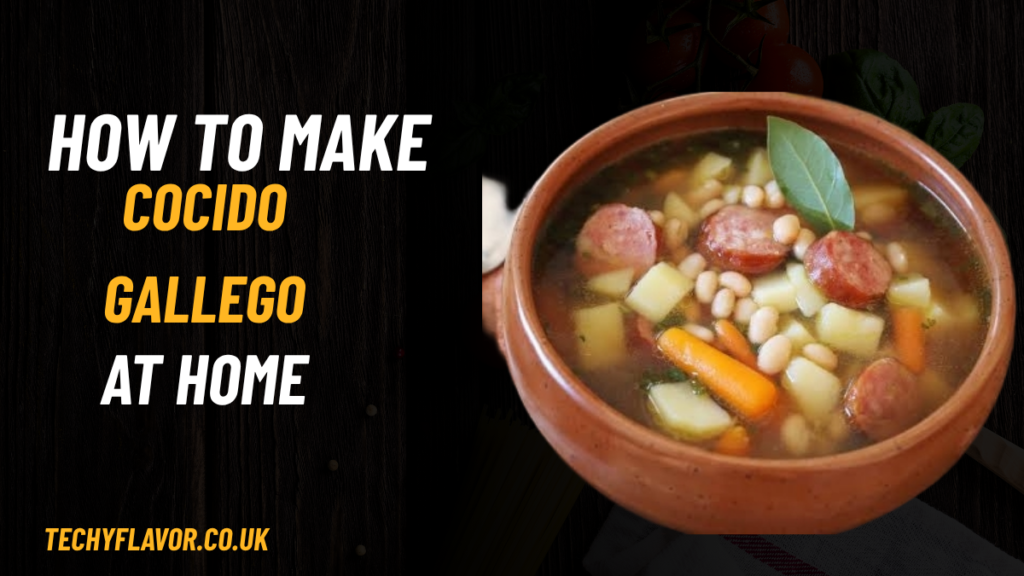
How to Make Cocido Gallego at Home
Prep: 30 minutes active, plus soaking/desalting
Cook time: about 2½–3 hours
Serves: 6
For a manageable home version, use about 1 kg lacón or cured pork shoulder, 500 g salted ribs, 250 g pancetta, two Spanish chorizos, 300 g dried chickpeas, 1 kg potatoes and roughly 700 g grelos or cabbage. Add a small piece of beef or half a chicken if you want a fuller celebratory pot.
Step One: Desalt the Pork
Put salted meat into cold water in the fridge for at least 24–48 hours, changing the water several times. Large traditional cuts can need considerably longer; Lalín guidance even recommends four days for some lacón.
Common mistake: rushing this stage. A perfectly cooked cocido can still be almost inedible if the cured meat remains aggressively salty.
Step Two: Soak the Chickpeas
Cover dried chickpeas generously with water and leave them overnight. Traditional guidance calls for soaking them the day before cooking.
Step Three: Start the Meat Slowly
Put the lacón, ribs and pancetta into a large stockpot. Cover with fresh water, bring gently towards a simmer and skim off foam.
Avoid a violent rolling boil. Slow cooking keeps the meat succulent and gives you a cleaner, more useful broth.
Step Four: Add Chickpeas and Other Meats
Add the drained chickpeas along with beef or chicken if using. Simmer gently until the pork and chickpeas are approaching tenderness.
Pro tip: do not add extra salt yet. Cured pork continues releasing salt throughout cooking.
Step Five: Cook the Chorizo
Add the chorizo during the later part of cooking rather than from the very beginning. Around 30–40 minutes is usually sufficient and prevents the broth becoming unnecessarily oily.
Step Six: Add Potatoes and Greens
Cook peeled potatoes and cleaned grelos in some of the meat broth until tender. If grelos are unavailable, turnip greens are the closest idea; cabbage or kale gives a less authentic but practical substitute.
Official Galician guidance notes that vegetables may be cooked in the same pot or separately depending on the recipe.
Step Seven: Rest, Taste and Serve
Let everything settle briefly, then taste the broth before adjusting seasoning.
Serve some broth first — often with thin noodles — followed by chickpeas, potatoes and greens, then the meats arranged generously on platters. Galician bread is almost compulsory in spirit. A fresh, acidic Galician red works beautifully against the richness.
Frequently Asked Questions About Cocido Gallego
Is cocido gallego the same as caldo gallego?
No. Caldo gallego is primarily a Galician soup, while cocido is a much larger meal built around meats, vegetables, potatoes and often legumes. Cocido broth may itself become the soup served at the beginning of the meal.
What is the difference between cocido gallego and cocido madrileño?
Both belong to Spain’s family of hearty boiled meals, but the Galician version is especially associated with cured pork, chorizo and grelos. Recipes vary considerably by family and region, which is why the restaurant’s origin matters.
Where can I find authentic Cocido de Lalín near me?
Search Google Maps for both “Cocido de Lalín” and “Galician restaurant”, then inspect recent menu photos and reviews. Because the dish is frequently seasonal, always telephone before travelling.
Is cocido gallego available all year?
Not everywhere. It is strongly associated with colder weather, and Lalín’s major cocido celebrations traditionally fall around the winter and Carnival period. Casa Currás, for example, places especially strong emphasis on cocido during its winter season.
Can I make cocido gallego without pig’s head or ears?
Absolutely. Those cuts belong to the traditional repertoire, but a home version using lacón, ribs, pancetta and chorizo can still capture the essential flavour profile. What matters most is good cured pork, correct desalting and well-cooked greens.
What can I use instead of grelos outside Spain?
Fresh turnip greens are the closest practical substitute. Kale or cabbage will work when necessary, although the final flavour is milder and lacks some of the characteristic bitterness that makes Galician cocido distinctive.
Final Thoughts
Cocido gallego is not fast food, and that is exactly its charm. From lunch in Lalín to community feasts in New York and seasonal gatherings in London, it remains the sort of dish that makes more sense when people sit down together and stop watching the clock.
When searching for the best cocido gallego near me, look beyond star ratings. Check the season, ask whether the meats are properly cured and desalted, look for grelos and lacón, and confirm the dish before setting off.
And if there is no authentic pot nearby? Make one at home. Invite people you actually enjoy spending three hours at a table with.
Bring an appetite, pass the bread, and let the cocido do the rest.
Read More Blog: